Tuesday, September 8, 2020

Visiting Artist Warren Neidich 6:15PM

 TONIGHT at 6:15PM: School of Art + Art History Visiting Artist Virtual Lecture: Warren Neidich.

To access the talk, go to UF College of the Arts YouTube channel – the livestream will pop up when we go live: https://www.youtube.com/channel/UCcUIacLwOcupTkofTR764_Q 

For comments / questions, audience members need to login to YouTube; comments will be moderated.
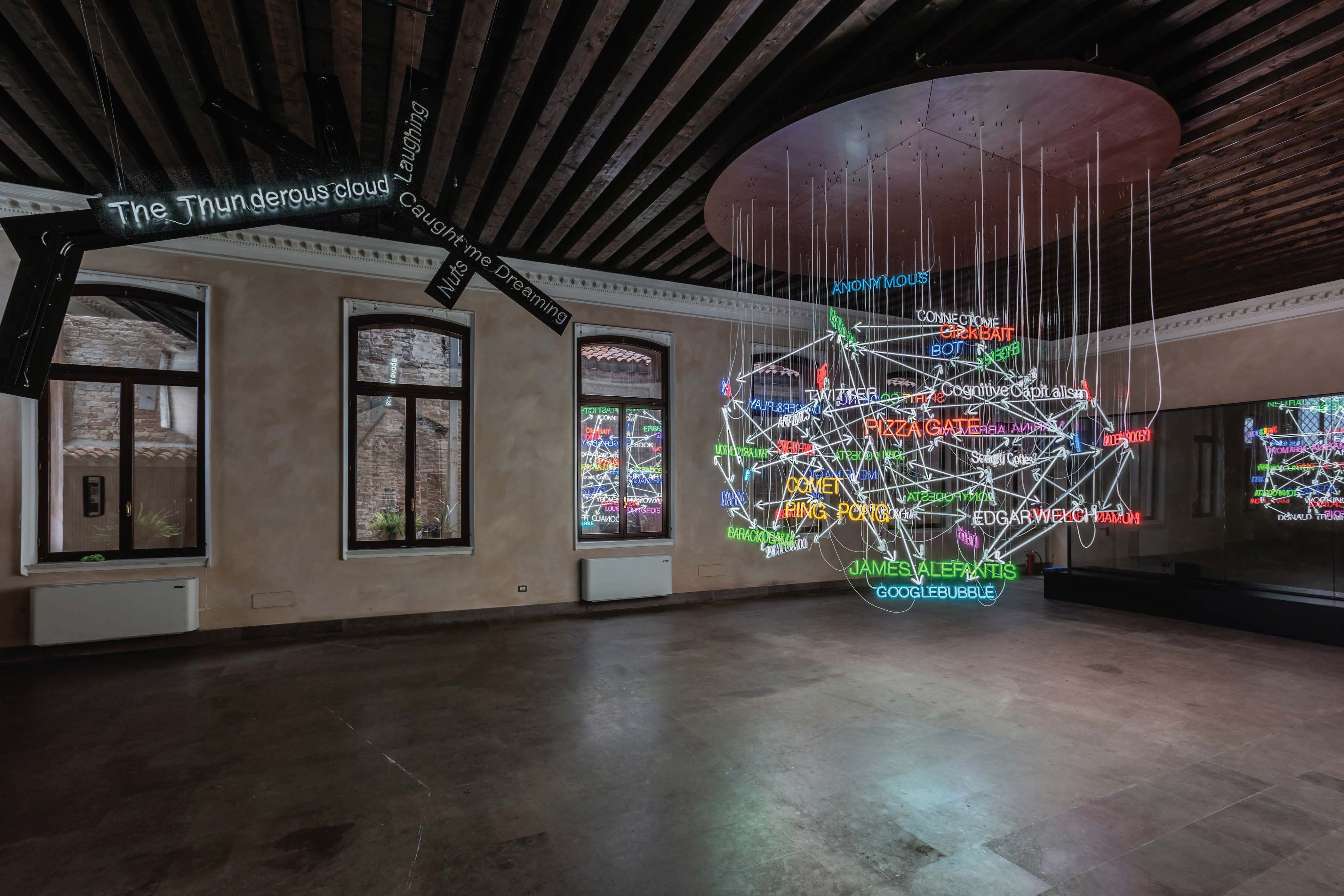
Warren Neidich 

Having studied photography, neuroscience, medicine and architecture, Warren Neidich brings to any discussion platform a unique interdisciplinary position that he calls “trans-thinking.” He currently uses video and neon to create cross pollinating conceptual text-based works that reflect upon situations at the border zone of art, science and social justice. His performative and sculptural work Pizzagate Neon (2018), recently on display at the Venice Biennial 2019, analyzed through a large hanging neon sculpture the relations of Fake News, networked attention economy, evolving techno-cultural habitus and the co-evolving architecture of the brain. His recent conceptual project Drive-By-Art (Public Sculpture in This Moment of Social Distancing) just opened on the South Fork of Long Island and Los Angeles to some acclaim including reviews in the NY Times, Hyperallergic, The Art Newspaper, Time Out and LA Magazine. He is founder and director of the Saas-Fee Summer Institute of Art (2015-), a theory intensive postgraduate course that attracts students worldwide operating in Los Angeles, NYC and Berlin. Additionally, he was a tutor in the departments of visual art, computer science and cultural studies at Goldsmith College London as well as recently serving as Professor of Art at the Weissensee Kunsthochschule, Berlin. He has been a visiting lecturer at the departments of art at Brown University, GSD Harvard University, Columbia University, Princeton University, Southern California Institute of Architecture, UCLA, La Sorbonne Paris, University of Oxford and Cambridge University, UK. He is the American editor of Archive Books and author of over 20 books. His recent books include The Glossary of Cognitive Activism, Archive Books, Berlin, and Neuromacht (in German) Merve, Leipzig.

*Visiting Artist Series lectures and studio visits will be virtual and online this semester. Please be aware students and the public are forbidden to tape or repost the online lectures and studio visits. UF will tape lectures with the permission of individual speakers and some of the talks will be available in the future for faculty, staff, and students.

https://www.warrenneidich.com

https://arts.ufl.edu/in-the-loop/events/visiting-artist-lecture-with-warren-neidich/

Thursday, September 3, 2020

SculptureCenter at The New School: Expanded, Exploded, Collapsed?, April 19, 2010, Part One


SculptureCenter, The New School: Expanded, Exploded, Collapsed?, 4 /19/10, Part 1 here

SculptureCenter, The New School: Expanded, Exploded, Collapsed?, 4/19/10, Part 2 here

Thirty years on from Rosalind Krauss’ seminal text Sculpture in the Expanded Field, a panel of artists and critics reconsiders the concept of the "expanded field" in light of contemporary art production. Co-sponsored by the Vera List Center for Art and Politics, the discussion reflects upon how performative, discursive, and design models developed since the essay's publication may have shifted the formal, political, and semiological parameters of sculpture today.

Moderator
Fionn Meade, Curator, SculptureCenter

Participants
Johanna Burton, art historian and critic
Josiah McElheny, sculptor and faculty member, Yale University
William Pope.L, performance artist and Professor of Theater and Rhetoric, Bates College

Brassai and Involuntary Sculpture


According to the Metropolitan Museum of Art the Surrealist artist, "Brassaï collected and photographed tiny castoff scraps of paper that had been rolled, folded, or shaped unconsciously by idle hands-readymade Surrealist objects that represent what Rosalind Krauss has described as "the automatic writing of the world." A selection of these images was published in the following year in the avant-garde magazine Minotaure accompanied by captions written by Salvador Dali."

"What happens when sculpture ceases to be quite so controlled, when

it lets itself be dictated by principles of chance, determined by its environment

or by the circumstances of its reception and documentation? For the brute

activities listed above we could substitute a different set of much less ‘voluntary’

ones: fingering, fiddling, propping and shuffling, to which should be added the

instantaneous snapping of the camera lens. Where sculpture is ‘found’ and not

‘made’, or indeed exists somewhere between the two, it can also become less

material and more obviously contingent – a form of a thing, or a formation of

things, captured at a specific time. If ‘voluntary’ sculpture suggests the production

of a deliberate material configuration, set forever in hard matter, ‘involuntary’

sculpture points to its own transience or its role as part of an ongoing process,

where it exists beyond a serendipitous photographic image.


This volume takes its cue from a selection of photographs by Brassaï with

captions by Salvador Dalí published in the surrealist periodical Minotaure in 1933

and bearing the title ‘Involuntary Sculptures’ (Figure I.1). Scraps of everyday

debris – including rolled-up bus tickets, a piece of bread roll, a curl of soap from a

sink and a blob of toothpaste – featured in photographic close-up as ‘automatic’

sculptural configurations. These banal and non-artistic objects (one of the tickets

was allegedly found screwed up in the pocket of a bank employee) were intended

at least in part as a riposte to the prevailing perception of sculpture at the time...


Brassaï and Dalí’s photo-essay provides a tantalising evocation of sculptural

possibility, where forms are both shaped by human hands, sometimes with

little conscious thought (the rolled bus ticket), and subject to ‘organic’ growth

(the piece of bread rising and changing shape in the oven). It also freezes its

array of objects at a given moment, before they are discarded, swept or wiped

away, dissolved or eaten... the parameters of ‘sculpture’ are challenged and expanded,

while photography fulfils simultaneous (and potentially contradictory) functions

of auratic reproduction and quasi-scientific documentation."


-Anna Dezeuze and Julia Kelly

Matt Calderwood, Scraps, 2011


Matt Calderwood, The Streets Present Scraps here. Calderwood's website here

According to the Guardian, Matt Calderwood was, "Born in Northern Ireland in 1975, Calderwood studied Fine Art at Newcastle and Sunderland. When not putting his materials through their paces in one of his perilous performances, he builds monumentally unstable sculptures out of plywood that rely on counterbalance to keep them steady. Both sculptures and performances require a steely control in the artist, and it is this paradox, the struggle of power between artist and objects, that makes his artwork so riveting. "

Christine Hill - Volksboutique


Christine Hill Volksboutique video here

Volksboutique project website here

Chistine Hill biography:

A resident of Berlin since 1991, American artist Christine Hill has spent her artistic career trying out other careers. Referring to these experiments as “organizational ventures,” rather than performance art or installations, she has opened ad-hoc businesses as varied as a tour guide company, a portable office, a massage parlor, and an apothecary. One of her most enduring works is the Volksboutique, which is comprised of a series of small shops that have popped up around the world. The small businesses combine the tradition of East German community shops—stocked by products made in her studio, the Volksboutique Products Division—with optimistic slogans rendered in red, white, and blue text. Like Andy Warhol, she continues the 20th-century tradition of exploring the relationship between art and commerce, with a bit of theater rolled in.

Robert Smithson, A Tour of the Monuments of Passaic, New Jersey


Essay here and here


Rosalind Krauss, Sculpture and the Expanded Field


Rosalind Kraus, Sculpture and the Expanded Field here